
By: Natasha Dolginsky Hau, Senior Vice President of Marketing | LINQ
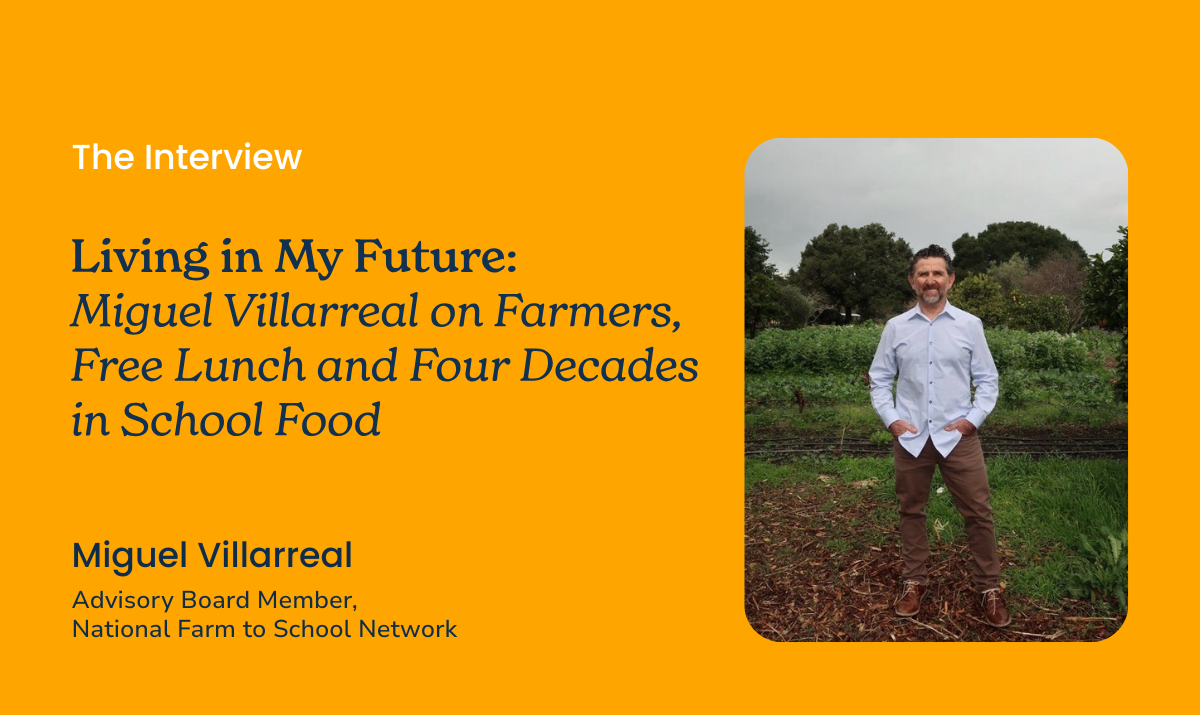
I recently had the pleasure of connecting with Miguel Villarreal, who has spent more than 40 years in school food. He grew up in a farming family and went on to lead school nutrition programs in Texas and California before becoming a national voice for farm to school. Today he serves on the advisory board of the National Farm to School Network. He likes to say he’s “living in my future,” because the rooms that once held a handful of people now hold hundreds. We talked about farmers, free lunch, a funny job interview in Dallas, and why connecting kids to the people who grow their food matters so much.
I’ll jump right into the post that made me reach out, about the California Farm to School Conference at Soil Born Farms. More than 900 people from 35 states and Tribal Nations. What was the feeling on that farm? It was such an incredible event! The overall feeling from everyone was that of hope and inspiration. Hope because we were surrounded by so many people, in one place, committed to doing this work. For me, it was a prophecy fulfilled of what we had talked about for a couple of decades.
And the inspiration part? It was inspirational because we all heard the stories from our one-on-one conversations, or from those on panels. These are the people that continue to create a better future for children, their families, farmers, and communities. They have not given up regardless of the obstacles they have faced along the way. It was also a time of deep reflection for me, realizing that we have so much of what we need to ensure we are successful, but how do we ensure the work we do is sustainable. That is what gives me motivation.
And from the sound of it, the people in that room are a big part of what keeps this work going. You wrote that the diversity of voices was a highlight: students, cafeteria staff, farmers, funders, state agencies. Whose voice stuck with you most? Honestly, everyone’s voice stood out to me. I had so many conversations with individuals that shared their stories of how they are creating a healthier community.
But if you had to pick one or two? If I was to elevate any of those voices, it would be the voices of the farmers and the youth. I have always been inspired by the work of the farmer, back to days when I myself was a young child and understood the nature of their work. Farmers are first and foremost taking care of the soil, which in essence, is caring for all of us and every living thing. They are truly the salt of the earth.
You mentioned understanding the farmer’s work all the way back to when you were a young child. Tell me more about your childhood. What did it teach you about food that you still carry? My parents had already been working for two decades as migrant farmworkers when I was born. And I would spend the next 17 years of my life living and working in this farmworker environment. I remember going through phases, where food represented different meanings at several stages of my childhood. As a very young child, before attending school, food represented the essence of love.
Ah, that sounds a lot like my grandmother’s kitchen. Probably a lot of grandmothers’ kitchens, yes. I remember gathering around the kitchen at my home or going over to the relatives. I remember the aroma of all the spices and the flavors it added. And I remember my family always being cheerful when preparing and eating the meal.
That sounds lovely. It was, for a while. But the next phase of how I came to view food wasn’t as lovely. At the age of eleven, I started to see food not as a source of love, but one of shame. It was then I first realized that I was not like many other children. I had been on the “Free Lunch Program” through elementary school, and I realized that free lunch meant something. It meant your family didn’t have much. Like many kids in the same situation, I chose not to eat in the cafeteria because of the stigma that came with it.
That must have been so hard. Lunch should be one of the best parts of a kid’s day, and no child should feel ashamed to eat it. That feeling stayed with me for a long time. But perhaps that’s why I still carry those lessons with me today, and why I’ve been fortunate to work a full career in school food service making sure children, families, and farmers are treated with dignity and respect.
You said food went through phases for you. Was there another one after that? Yes. It was also during this time, in my early teens, that I became intrigued with food for health reasons. I was keenly interested in learning how food could keep me from getting ill and help me develop strength and energy. This was such an interest that I ended up studying and getting a degree in Food and Nutrition to figure out how I could apply all this knowledge in my career.
And that degree eventually led you to school food. Was that something you ever imagined doing? No, I never imagined that I would work in school food services my entire career. I was working in a hospital as a diet technician while I was still in college. I also had the opportunity to do bedside observational visits with the hospital dietitian. It was the first time I had met people with chronic health issues such as diabetes, kidney disease, and cardiovascular disease. It was at that moment that I knew I wanted to work in a field that kept people out of the hospital. I did not know if it would be school food service.
So how did Dallas happen? Well, I graduated in 1982 and, thanks to a lead from my college professor, got an interview with the Dallas Independent School District. The interview panel was made up of ten school food service women and one male administrator. The women asked all the great questions. At the end of the interview, the lone male administrator finally spoke up. He said, “Why would you want to work in a field that is primarily led by women?” I looked at him with all seriousness and said, “I want to show these women that a man can do the job as good as they can.” The room erupted in laughter.
I love that. Usually it’s women walking into a room full of men, trying to prove they’re just as good. Honestly, I didn’t know at the time why that remark was so funny to all of them. Needless to say, I was hired soon after.
That was more than 40 years ago. What’s changed most in school food since then? People often hear me say, “I’m living in my future.” What I mean is that decades ago there were just a handful of people that would gather around a table to discuss how the food system could be improved. Those people were primarily health professionals. And there were few of them. Not hundreds of concerned individuals of all ages and from throughout the spectrum of health: students, teachers, parents, farmers, healthcare, higher education, business leaders, elected officials and many others. This took years of advocacy to attain this level of education.
That’s a big shift, from a handful of people around a table to hundreds. And you mentioned earlier that what’s on your mind now is how to make this work last. With all those people in the room, what still hasn’t changed? Farm to school programs still haven’t reached a level of sustainability in communities across the nation. I believe that we must address what is keeping these programs from becoming sustainable. It will require us to look at a system that has been largely driven by federal and state policies that are not entirely focused on improving the culture of health and wellness in all communities. This is the area I want to focus on with all the people who are now in the room.
Farm to school is a big part of that work. For anyone newer to the idea, what does it really mean? Farm to school can be more accurately understood as farm to table. Tables that exist in every community. In our homes, schools, institutions, restaurants. It’s about reconnecting the people that grow that food with the people who are involved in the entire food chain. From all those who harvest, distribute, store, prepare, serve, teach, and eat the food.
So what does that look like in a school? It involves the procurement of local foods, educational experiences through gardens and/or farm visits, education in the classroom, and creating partnerships to connect all this work in communities for children.
That’s a lot of pieces to pull together, especially for a district just getting started. If they could only pick one thing this year, where should they start? I would suggest that the food service director and partners host a one-day farm to school luncheon at one of their schools. The menu would include as many locally grown foods as possible.
A whole lunch made from local food. That feels like the easiest way to show people what farm to school actually is. So who’s on the guest list? As many partners as possible. I would also encourage the director to invite an elected official and the media. The partners would be asked to help during lunch service in the cafeteria while the kids are all being served. Partners should also be scheduled to sit with the kids during lunch and engage them in conversation.
I love picturing a farmer sitting down to lunch with a table of third graders. That’s exactly the kind of connection you talked about, kids meeting the people who grow their food. What happens once the last tray is cleared? The director could hold a short presentation about how farm to school has been administered and talk about future plans, with a short Q&A with all of the partners and media. It’s a simple and effective way to market your farm to school program with all your partners and get great media coverage.
Inviting an elected official is such a smart move. How else does a director convince a superintendent or school board that farm to school is worth the time? This is something every school food service director has to figure out to be successful. And most of the convincing happens long before anyone walks into a board meeting. It begins with relationships. The kids, the teachers, and the administrators. Then parents, farmers, community leaders, and a host of other local partners. Once those people are engaged, they make the case for you. A superintendent sees it in the cafeteria when kids are lining up for something grown just down the road. A board member sees it standing in a school garden or on a farm visit. When people see it for themselves, they get it.
So the best argument is the work itself. That’s a lot of relationships to build, though. Where can a director go for help? The good news is that directors don’t have to do this alone. There is so much more support today than when I started. The National Farm to School Network connects people from all over the country who are doing this work, so you can learn from someone who has already been where you are. It shares resources and helps advance policy at the state and national level. Then there are state agencies, through the Department of Education or the Department of Agriculture. They provide training on procurement, food safety and operations, help with grants, and help connect schools with local farmers. My advice is to reach out. The people in this movement love helping each other.
And once a director gets started, how do they know it’s working? Some of it is easy to count. What local foods you’re buying, how much, and how often they show up on the menu. Student participation is a big one, too. If more kids are eating, that tells you something. But one of my favorite measures is what happens at home. Are families bringing more local foods into their own meals? When a child goes home and asks for the vegetable they tried at school, you know it’s working.
I love that it can reach all the way into families’ kitchens, like the one you grew up in. Early on, you said the youth voices at the conference stood out to you. After all these years, is that what gives you hope? Yes. The youth voices are absolutely essential to this work. Their efforts will nurture the seeds of change that have long been planted by those that came before them. When I was a boy, I didn’t want to eat in the cafeteria. Today, I see kids growing food in school gardens, sitting down to lunch with the farmers who grew it, and taking what they learn home to their families. That’s why I say I’m living in my future. And I can’t wait to see the future they create.