
By: Natasha Dolginsky Hau, Senior Vice President of Marketing | LINQ
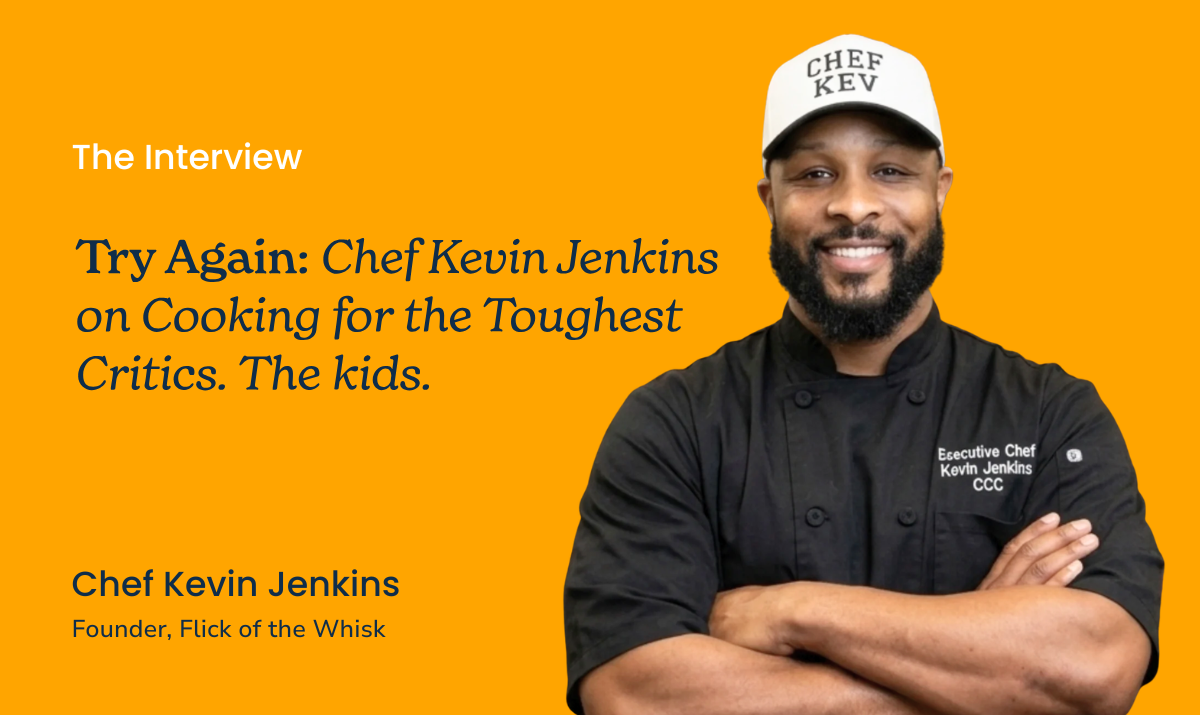
Last week I had the pleasure of connecting with Chef Kevin Jenkins, whose career has taken him from the Navy to corporate dining rooms to school kitchens, most recently as executive chef at Garland ISD (Independent School District) in Texas. He says kids are his toughest critics. Today, through his company, Flick of the Whisk, he trains school kitchen teams across the country. His philosophy fits in two words: Flavor First. We talked about grandmothers, collard greens and why the best feedback a chef can get is ‘try again.’
Let’s start with your LinkedIn post about flavor. You wrote that good food can change participation. A lot of people in school nutrition would agree. So what makes it hard to put more flavor on the tray? I think sometimes we make flavor harder than it has to be. School nutrition teams are balancing a lot at once. U.S. Department of Agriculture (USDA) requirements, food costs, labor, equipment, procurement, allergies, production schedules, and then hundreds or thousands of students who all have different preferences and opinions about what you’re serving. Flavor can sometimes become one more thing we’re asking the team to think about. But I don’t believe flavor has to mean expensive ingredients or complicated recipes.
I’ll be honest, when I think of great flavor, I do think “more expensive.” A lot of people make that assumption, but packing school meals with flavor doesn’t have to be expensive. Sometimes it’s seasoning food properly. Sometimes it’s roasting instead of steaming. Sometimes it’s adding a sauce or building another layer of flavor. Sometimes it’s looking at a USDA Foods item you’ve used the same way for five years and saying, “Okay, what else can we do with this?” And trust me, kids notice.
Oh, I’m sure kids notice. It’s hard to put anything past them, especially when it comes to food. Exactly! My own kids come home and give me the school food report all the time. They’ll let me know if the quesadillas were on point or if they were lacking flavor. They’ll tell me if the mac and cheese tasted like that down-home mac and cheese they know, or if it tasted like something straight out of a box. And they’re talking to a chef at home, so you know I get the full review!
And what do you tell them back? I use those conversations as an opportunity to explain something important. I tell them everything isn’t going to taste exactly like what you grew up eating or what you remember from home. Food is personal. It’s cultural. A quesadilla, collard greens, rice, mac and cheese, or even something as simple as beans can taste completely different depending on who cooked it and what household or culture you grew up in.
I know that feeling. I remember my grandma’s pelmeni, the Russian dumplings I grew up with. Nobody else’s ever tasted quite like hers. That’s exactly what I mean. But we shouldn’t expect every school recipe to taste like Mom’s or Grandma’s. Still, good is good. That’s the standard I keep coming back to.
“Good is good.” I like how simple that is. So what does “good” mean to you? Good means the food doesn’t have to taste exactly like my version, your version, or Grandma’s version. But it should be seasoned. It should be prepared with care. And it should be something we’re proud to put in front of students.
Is that where your Flavor First philosophy comes from? Absolutely! I believe nutrition matters. Compliance matters. Cost matters. But we can hit every nutritional target on paper, and if the food ends up in the trash, we missed the point. Flavor isn’t competing with nutrition. Flavor helps us deliver nutrition because first, we’ve got to get kids to eat the food.
Every nutrition director I know would agree with that statement. And getting kids to eat the food starts with the people making it. You talk a lot about how good training can change a kitchen. When you walk into a district for the first time, what’s the first thing you look at to know whether the team is ready for more scratch cooking? I talk to the staff. Period. Before I start looking at recipes, equipmentor anything else, I want a baseline. What do they think scratch cooking means? What do they believe they’re capable of doing? What are they comfortable with, and what makes them nervous?
It’s interesting that you start with what they believe, not what they can do. And your first question is what they think scratch cooking means. What does it mean to you? Actually, I don’t use the term “scratch cooking” very often anymore. I prefer “freshly prepared.”
Great reframe. Where did that come from? I picked that up from a previous director I worked with, and I thought it was genius. “Scratch cooking” can sound intimidating. You say scratch and suddenly people think Chef is about to have them making their own cheese in the back of the kitchen! That’s not what we’re talking about.
Scratch cooking does sound intimidating! So what are you talking about when you say “freshly prepared”? I’m talking about progress. I’m talking about not serving fully pre-packaged meals. Once I’ve talked with the team, I start looking at what they’re already doing. And a lot of times, they’re further along than they realize. Maybe they’re making salads every day. Maybe they’re preparing a sauce instead of opening a packet. Maybe they’re cutting fresh vegetables, seasoning proteins, assembling a dish or taking a convenience product and adding fresh ingredients to it. I’ll point those things out and say, “You know you’re already doing some of this, right?” That’s important because now we’re not starting from zero.
I imagine that recognition means a lot to a team. So what comes next? From there, I can start identifying where we can take the next step. Maybe that’s knife skills. Maybe it’s making one sauce in-house. Maybe it’s changing a cooking technique or teaching the team how to use a piece of equipment differently. And then I get to work.
How long does that work usually take? Sometimes it takes several days. Sometimes it’s several weeks. The goal isn’t for me to walk into a kitchen, flip a switch and suddenly declare, “Congratulations, you’re a scratch kitchen.” The goal is to build on what the team is already doing, develop their skills and confidence, and move them toward more freshly prepared food in a way they can actually sustain after I leave. You’d be surprised how often the biggest change starts with showing people that they’re already more capable than they thought they were.
How so? One of the things they taught us as Culinary Specialists in Navy “A” School, which is basically our culinary training school, was that one person should be able to feed 500 people. I don’t know why, but that stuck with me. Even now, when I walk into a short-staffed school kitchen, that phrase is somewhere in the back of my mind. Not because I expect one person to literally do everything or because being short-staffed is okay, but because the Navy trained me to think about efficiency differently.
What does that kind of efficiency look like in a school kitchen? It can mean many things. For example, how do we organize the work? What can we accomplish with the people and equipment we have? Where are we losing time? How can we simplify something without sacrificing the quality of the food? The Navy taught me to work with what I have and scale from there.
And probably trade a few grandmothers’ recipes along the way. Ha, more than a few! And of course, the Navy gives you the core values of Honor, Courage and Commitment, and those stay with you. But being a Culinary Specialist also taught me things that still show up in my work every day: attention to detail, organization, consistency, adaptability and how to produce good institutional food at scale. And I think that last part is important.
“Institutional food” doesn’t usually get a great reaction, does it? Not often. But “institutional food” doesn’t have to mean bad food. The Navy taught me early in my career that you can feed hundreds or thousands of people and still care about what goes on the plate. That mindset translated almost perfectly into school nutrition.
When you put it that way, it absolutely does. And you did translate that into school nutrition. But why the pivot? Why schools? Honestly? It wasn’t intentional at all. When I moved to Dallas, I was looking for a new opportunity and really just trying to shift gears in my career. Jennifer Miller, who would become my director at Garland ISD, came across my résumé and reached out to me. And strangely enough, it wasn’t necessarily the job opportunity itself that made me change course. It was Jennifer.
So it was the person, not the job. I’ve seen firsthand how a good leader can change everything. What stood out about Jennifer? Her communication was quick, she was direct about what she was looking for, and she had a clear vision for what she wanted me to bring to the program. That was something I admired immediately and eventually came to value even more while working with Jennifer. Then I got into Garland and the team there opened my eyes to the world of student nutrition.
What surprised you most about that world? Like a lot of people, I went through the public school system. I ate school lunch. But I had absolutely no idea what was happening behind the scenes to put that food on the tray.
I find a lot of people are that way. I was too, before I started working at LINQ and got to see behind the scenes. What did you find back there? The scale, regulations, nutrition requirements, procurement, commodities, labor, equipment, menus, production records. I remember thinking, “Wait, all of this is happening just to get lunch out every day?” It was eye-opening.
When did it go from eye-opening to something you loved? The moment I fell in love with the industry was when I attended my first School Nutrition Association Annual National Conference in Florida. I came from the traditional culinary world, and there’s a lot of competition in that world. Who’s the better chef? Who has the better restaurant? Who has the better food?
Who has more Michelin stars? Ha, exactly. And then I walked into student nutrition and felt something completely different. Of course districts want to do great work and everybody has their own ideas, but underneath it all there was this common goal: Feed students good food. That’s it. Whether you’re a chef, dietitian, director, manufacturer, broker, trainer or cafeteria manager, at the end of the day we’re all trying to figure out how to feed kids better. I remember looking around that first conference and thinking, “Yeah, I can get behind this.” And I’ve been hooked ever since.
And that love has taken you into national work too. You’re involved with the Culinary Institute of America’s Healthy Kids Collaborative, which focuses on improving school food nationally. What do you think school kitchens are getting right that the rest of us don’t hear about? The intention behind it all. I think that’s what people on the outside don’t always see. It’s easy to look at a school meal and think, “Oh, they’re just serving whatever they can put on a tray.” No. There is so much happening behind that tray. There are people thinking about nutrition, allergies, food safety, cost, procurement, USDA requirements, equipment, labor, student preferences and whether the kids are actually going to eat it. Then somebody still has to prepare it, serve it and do it all over again tomorrow.
And someone has to get all of that right, every single day. Exactly. One of my mentors, Chef Rachel Petraglia, says, “How you do one thing is how you do everything.” That’s something I couldn’t agree with more.
Do you see that in the school kitchens you visit? I sure do! I’ve been fortunate enough to walk into school kitchens across the country, and what I wish more people could see is how much these teams care.
I see that care in so many of the districts we work with at LINQ. What does it look like up close for you? I’ve met directors who are constantly thinking about how to improve their menus. I’ve met managers who know their students by name and know exactly which meals they’re going to get excited about. I’ve worked alongside cafeteria teams who take real pride in what leaves their kitchen. Is every meal perfect? Of course not. But don’t mistake imperfection for a lack of care.
Is that care what drew you to the Healthy Kids Collaborative? Yes, that’s one of the reasons the Collaborative has been so inspiring for me. You get a room full of incredibly bright people from different parts of this industry who all want to push school food forward and, just as importantly, help the rest of the world understand what student nutrition actually is.
Why does that matter so much to you? Because there’s a much bigger story happening inside America’s school kitchens than most people realize. There are a whole lot of people behind that tray who genuinely care about the kid receiving it. And I love being part of an industry that’s working to make sure people finally see that.
You’re helping tell that story through your own company too. When did you start Flick of the Whisk? And why decide to grow it now? Flick of the Whisk started in 2025 the way I think a lot of chef businesses start: catering. My wife actually came up with the name, which I have to give her credit for! At the time, I don’t think either of us knew what Flick of the Whisk would eventually become. It was a way for me to cook, cater and build something of my own.
And then? And then I entered student nutrition. As I learned how to operate in this corner of the food industry, I started doing a little consulting on the side. I began working with districts and manufacturers, and I kept hearing the same kind of feedback: “This was helpful.” “Our team needed this.” “Can you come back?” “Can you help us with this next?” And the opportunities kept growing.
What made you keep saying yes? One thing about me is that I love helping people build. I actually like to think of myself as a builder who isn’t handy. Put a hammer in my hand and we might have some problems! But give me a kitchen, a culinary team, a menu or an idea that somebody is trying to develop, and now I’m interested. That’s what consulting started to feel like for me.
Almost like it’s not even work. Like that saying, “Find a job you love, and you’ll never work a day in your life.” I love that quote, but I don’t know if I’d go quite that far, because trust me, there are definitely some work days! Still, I understand the meaning behind it now. Most of the time, it never really felt like work. Helping a district develop its culinary program, helping a chef build confidence, helping a manufacturer understand how its product can actually work in a school kitchen, those things felt natural to me. Eventually I had to recognize that Flick of the Whisk had grown beyond what it originally was.
So what did you do about it? I decided to press harder and intentionally build a business around the work I already loved doing. At its core, the purpose of Flick of the Whisk is pretty simple: Help school districts and food manufacturers feed kids good food. Period. Everything else we’re building comes back to that.
Districts and manufacturers sound like pretty different clients. When they call you, what are they usually asking for? And what do they actually need? On average, a district will call and say something like, “We want to do more scratch cooking,” or, “We want to expand our culinary capabilities.” Manufacturers usually come from a different direction. They’re asking, “How can we help districts use our products?” or “How can we help increase participation in the districts we’re already in?”
Do they have anything in common? They sound like two completely different conversations, but to me, they’re really not. The end goal is usually the same: increased participation and better food going into the next generation. That’s something I know I can help with.
Let’s start with districts. What are they really asking for? When a district says, “We want to move toward scratch cooking,” what they’re usually asking for is a foundation. Where do we start? What skills does our staff need? What can we realistically make with the labor and equipment we have? How do we write recipes that work in our kitchens? And probably the biggest one: How do we get our staff confident enough to cook good food for their students?
Why is confidence the big one? Because you can give somebody 100 scratch recipes, but if the team doesn’t have the confidence, skills or systems to execute them, congratulations, you now have a really nice binder.
That sits on a shelf. Right. That’s where we start working. We establish the foundation, figure out what the team is already capable of, identify where we can grow, and then start building from there.
And manufacturers? It’s similar. Having a great product is one thing. Understanding how that product actually fits into a school kitchen, works within a menu, helps the staff operationally and ultimately gets students excited to eat it is another. That’s the intersection I really enjoy working in.
So two sides of the same coin? Very much so. Whether I’m sitting across from a school nutrition director or a food manufacturer, I’m usually asking some version of the same question: How does this help us feed more kids better food? If we can answer that, we’ve got somewhere to start.
Speaking of kids, you’ve said they give you very honest feedback, not the polite answer. What’s the harshest thing a student has told you about your food? And did you change anything because of it? Kids will humble a chef quickly! I remember telling a student that we were putting collard greens on the menu, and immediately the student said, “I can’t wait. I hope they taste like my grandmother’s, or even my mom’s.”
Oof, there’s the grandma again. You can’t win against a grandma, can you? Not usually! But as a chef, I’m thinking, “Alright, challenge accepted.” We rolled out the recipe. I went back to the school, saw the student’s face, and I already knew. Then came the review: “These taste nothing like my grandmother’s. Try again.”
That’s it? Just “try again”? Sorry, I’m trying not to laugh. That’s it! No stars. No comment card. Just, “Try again.” Go ahead and laugh! And honestly, that’s part of what we do. School food takes trial and error. We have to be willing to listen, make adjustments and come back saying, “Alright, I’m pretty sure I can change your mind this time.” But that interaction also reminded me of something important about culturally familiar foods. When we put collard greens on that student’s tray, they weren’t comparing them to another school’s collard greens. They were comparing them to home. Mom’s greens. Grandma’s greens.
That’s a high bar, Chef! Yes, and I think that’s something we have to respect when we’re developing school menus. Food carries memories, culture and expectations with it. We may not be able to recreate every student’s grandmother’s recipe, but we can listen when students tell us what works and what doesn’t. That’s why I believe student feedback isn’t something we collect after the work is finished. Student feedback is part of the work. At the end of the day, I can think my recipe is amazing. I can love it. I can defend every ingredient in it. But I’m not the customer. Sometimes the best thing a chef can hear is: “Try again.”
And once they’ve raided the pantry? I’d also remind them that you don’t have to go from where you are today to completely scratch, or freshly prepared, next week. Maybe you have a premade item like a crispito or chicken patty. Okay, let’s make a really good sauce for it. That’s a win. Let the staff get comfortable making that sauce. Let them taste it. Let the students try it. Once the team has that down, maybe we move toward seasoning and preparing some of our own proteins. Then we build from there.
If you could leave every nutrition team reading this with one piece of advice, what would it be? I think sometimes we look at the end goal and get overwhelmed by everything that has to happen to get there. But you know the saying: How do you eat an elephant? One bite at a time. That’s how I approach almost every operational task that feels too big or daunting. You don’t need to transform your entire menu next month. Take one bite. Get one win. Then take the next one. And six months from now, you might look back and realize your team is doing things they never thought they were capable of doing. That’s how you build confidence. That’s how you build a culinary culture. And ultimately, that’s how you start putting better food on the tray without overwhelming the people responsible for making it happen.