
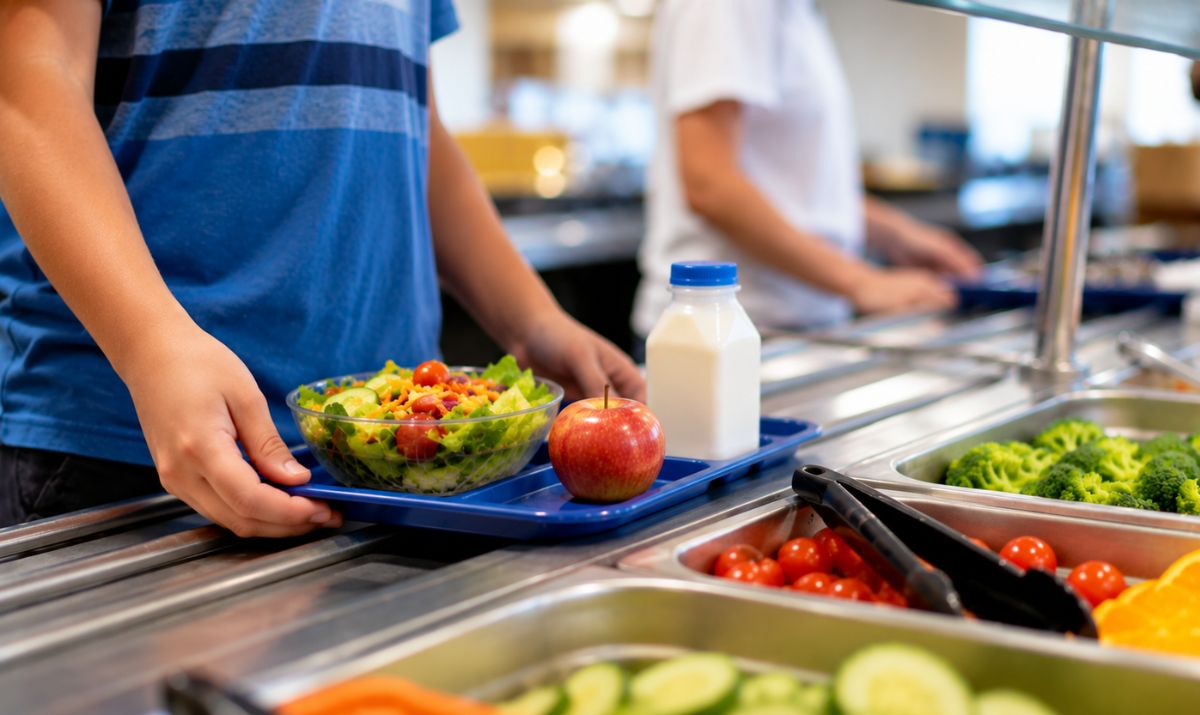
Every nutrition director knows the feeling: the bell rings, kids line up, and the race is on to serve each one with enough lunch period time left to enjoy their meal. Everybody wants to make school lunch lines move faster. Too often, though, kids feel rushed by the time they sit down. Trash cans fill up with half-eaten trays, and kids head back to class relying on the chance to get a quick snack later. It plays every single day in cafeterias across every state.
The good news is that a slow school lunch line isn’t a mystery. It’s the result of a handful of predictable pressure points: staffing, checkout, scheduling, menu complexity, and how much thinking a student has to do before they reach the register. Fix those, and the line speeds up.
That’s what we learned from Ryan Kay, Child Nutrition Coordinator for Nebo School District in Spanish Fork, Utah. He spent the last three years doing exactly that across 47 kitchens serving 44K students. His team has gotten high school lunch line wait times down to around eight minutes. Ryan joined us for a live webinar to share the secretes, and he says they’re moves any district can make.
1. Start With Readiness, Not Speed
Before a school lunch line can move fast, it has to be ready to serve. If food isn’t prepped and staff aren’t in position when the bell rings, the line becomes a holding area while the kitchen catches up.
“Without the staff, of course the lines are going to be slow. The product isn’t ready. We’re still hustling to pull things out of the oven as kids are waiting in line.” —Ryan Kay, Nebo School District
Fully staffing kitchens and training sets the baseline everything else builds on.
Hiring is its own challenge, and Ryan’s team got creative about where to look. “If we have openings, we go out to football games and have the announcer say it over the speakers,” he said. “We have a captive audience of parents who don’t necessarily check the job board, but they’re at the game on a Friday night.” Recruiting where families already gather reaches candidates that a job posting never will.
2. Put a Terminal on Every Line
One of the fastest ways to add school lunch line capacity with the staff you already have is to stop treating checkout as a specialized job. When only one or two people can run the POS system, every line funnels through the same bottleneck.
Nebo used to be limited by the number of employees they had specifically trained to run a checkout terminal. The POS system they used before LINQ Nutrition was difficult to navigate and didn’t offer an intuitive training mode, which meant cross-training was out of the question. When they switched, that changed immediately.
“It’s so user-friendly that we could start cross-training. Now our whole kitchen staff can serve or run the terminal.” —Ryan Kay
Nebo went from two terminals stationed out front to five POS stations that can run on WiFi (one per line), and every one of them is now staffed by someone who can both serve and check out.
3. Match Your Checkout Mode to the Building
An elementary cafeteria experiences its own common challenge. Younger students who haven’t memorized their ID numbers can stall a school lunch line.
When Nebo moved to full-day kindergarten for the first time, that problem arrived immediately. Hundreds of five-year-olds, none of whom knew their account numbers, none of whom had ever been through a lunch line, needed to get fed quickly. LINQ Nutrition’s photo mode solved it.
“Their photos show up on the screen by class. They tell you their name, you verify the face, and that’s it.” —Ryan Kay
The lesson travels beyond kindergarten. The flexibility to build checkout around how each site’s students show up is critical.
4. Build Confidence Before the Rush
New technology only speeds up a line if the staff trusts it. Nebo trains employees in a practice environment. A yellow banner marks practice mode on screen in LINQ Nutrition, so employees can learn without the pressure of real transactions, kids eager to eat, and a line that’s stretching toward the door. Training mode gives them experience with the system before they ever handle a live transaction.
“You can throw scenarios at people, like someone hands you a $5 bill, what do you do? It’s not affecting student accounts, it’s not affecting anything, but you’re building confidence before you go live.” —Ryan Kay
When Nebo implemented LINQ Nutrition before the start of the school year, the LINQ team came on-site for multiple training sessions, answering every question, going deep on how and why the system works. “It was a new program. But we were ready.” When more people can run any station it strengthens the team, helping to mitigate issues like absences, turnover, and the days everything goes sideways at once.
5. Collaborating on the Schedule with Principals
Some of the biggest school lunch line bottlenecks have nothing to do with the kitchen. When an entire grade is released at the same minute, the cafeteria line becomes the schedule’s shock absorber. It takes the full force as hundreds of hungry students arrive at once.
Ryan spent several years as an elementary principal before moving to nutrition, and he’s candid about what he didn’t understand at the time.
“I would build my lunch schedule, send fifth grade, and stand there asking why it was taking so long. I didn’t understand that a spaghetti day takes a lot longer to serve than a pizza day.” —Ryan Kay
Now his team invites principals at each campus to watch service in person, then they work together to stagger class release times by a minute or two. The payoff goes beyond speed. With less chaos in line, kids can more easily focus on reading menu boards and deciding what they want before taking their first item.
6. Make it clear what’s served in each line
Knowing what’s on the menu is one thing, but Ryan said it’s just as important to make it clear where each item is served. If a student needs to change lines or arrives at the front confused about what’s available, it eats into their meal time.
“You have to shout from the rooftops what’s being served on each line, because if a kid gets in a line expecting one thing and it’s not there, now they either take what they didn’t want or go get in another line, and that slows everyone down.” —Ryan Kay
The same logic applies to new menu items: label them so kids don’t have to ask what they are. Signage does the heavy lifting. Nebo’s secondary schools moved to digital menu boards two years ago. “As soon as they walk in and look up, they should be able to read it and know what’s on each line,” Ryan said. The boards also let staff connect with students by posting something as simple as a good-luck message for a school team playing that day.
7. Take the Decision Out of the Line
The fastest thing a student can do at the register is nothing: no digging for a number, no deciding what to grab, no confusion about their balance. Moving those decisions upstream, before the student is anywhere near the school lunch line, is where technology makes its biggest contribution to line speed.
Before LINQ Connect, Nebo didn’t have a family-facing app for meal payments, menus, and alerts. That meant balance questions, payment calls, and menu confusion all landed at the register. Now families manage everything from one place.
“They can view their balance, make a payment, transfer money between siblings, view the menu, and set up automatic payments. It was a true game changer for us.” —Ryan Kay
The transparency changed conversations with families, too. “Parents can look at their own transactions and go, oh, they’re eating breakfast and lunch every day. I didn’t know that,” Ryan said. “We take that as a compliment, because it means we’re putting out food kids actually want to eat.” Publishing menus in advance through LINQ Connect carries the same benefit: families see the week’s choices before students ever reach the counter, so the decision is already made by the time they’re in line.
What Faster School Lunch Lines Add Up To
Since Nebo connected LINQ Nutrition’s front-of-house and back-of-house operations, even the kitchen workflow accelerated. Staff at each kitchen can enter production data, place orders, and manage inventory on their own device and it syncs across the district. From his desk, Ryan can see what’s in every pantry and walk-in, adjust menus on the fly, and easily initiate transfers. It all translates to less time spent in spreadsheets and data corrections and more time building recipes, menus, and cafeteria experiences kids love.
Nebo’s high school participation has climbed every year since the team started working through these pressure points, and Kay ties that directly to speed.
“We’re always comparing it to when we go out to lunch with friends. What are we looking for? Good service, good food, quick, where you can sit down and visit. That’s exactly what we want for our students every single day. And it’s working.” —Ryan Kay
Want the full conversation?
Watch Make Cafeteria Lines Fly: How to Give Students More Time to Eat for more from Ryan Kay.