
Food waste in schools can be one of the most expensive problems hiding in plain sight. It shows up as fruit dumped whole into the trash, milk cartons barely opened, and trays scraped half-full into the bin at the end of a rushed lunch period. Individually, it doesn’t look like much. Added up across a district and a school year, it’s a lot of real money and real food walking out the door.
The good news is that food waste in schools is one of the most studied problems in child nutrition, and the strategies that work are well documented, low-cost, and within a school nutrition director’s control.
How much food waste in schools happens each year?
According to the Food and Agriculture Organization of the United Nations, roughly a third of all food produced globally for human consumption is lost or otherwise wasted. That’s about 1.3 billion tons per year. In the United States, the U.S. Department of Agriculture‘s Economic Research Service estimates that most of that waste, around 31%, happens at the retail and consumer levels.
Understanding where the waste comes from is the first step to cutting it. Many of the factors causing food waste across the whole economy relate directly to why K-12 nutrition programs see food spoil or go in the trash.
Six strategies to reduce food waste in schools:
1. Start at the source: Buy and produce what you’ll definitely use.
The EPA’s Food Recovery Hierarchy ranks source reduction—producing only what’s needed—as the single most preferred way to cut waste, ahead of donation, composting, or disposal. For a nutrition program, source reduction is a purchasing and production discipline:
- Order to real demand. Use production records and the USDA Food Buying Guide to buy what you need rather than what you ordered last year. When a surplus of an item is sitting in storage, hold off on reordering it until the stock draws down.
- Protect what you buy. Correct receiving and storage temperatures keep product usable instead of spoiled. Watching cooler, freezer, and storage-room temperatures closely is a direct waste-reduction move.
- Train your staff well. Prep waste from fresh fruits and vegetables drops when staff have solid knife skills, and careful cooking keeps batches from being burned or overcooked into the trash.
This is where visibility pays off. When purchasing, production, and inventory work from the same data, a program can order closer to actual demand and stop the pre-consumer waste that comes from guessing.
2. Give kids choice: Offer versus serve, salad bars, and sliced fruit
Waste drops when students get to choose what goes on their tray.
Offer versus serve lets students decline some of the components in a reimbursable meal. When kids take only what they’ll eat, less food hits the trash, disposal costs fall, and more meals still credit as reimbursable. Research shows that offer versus serve is especially effective at reducing waste in elementary grades.
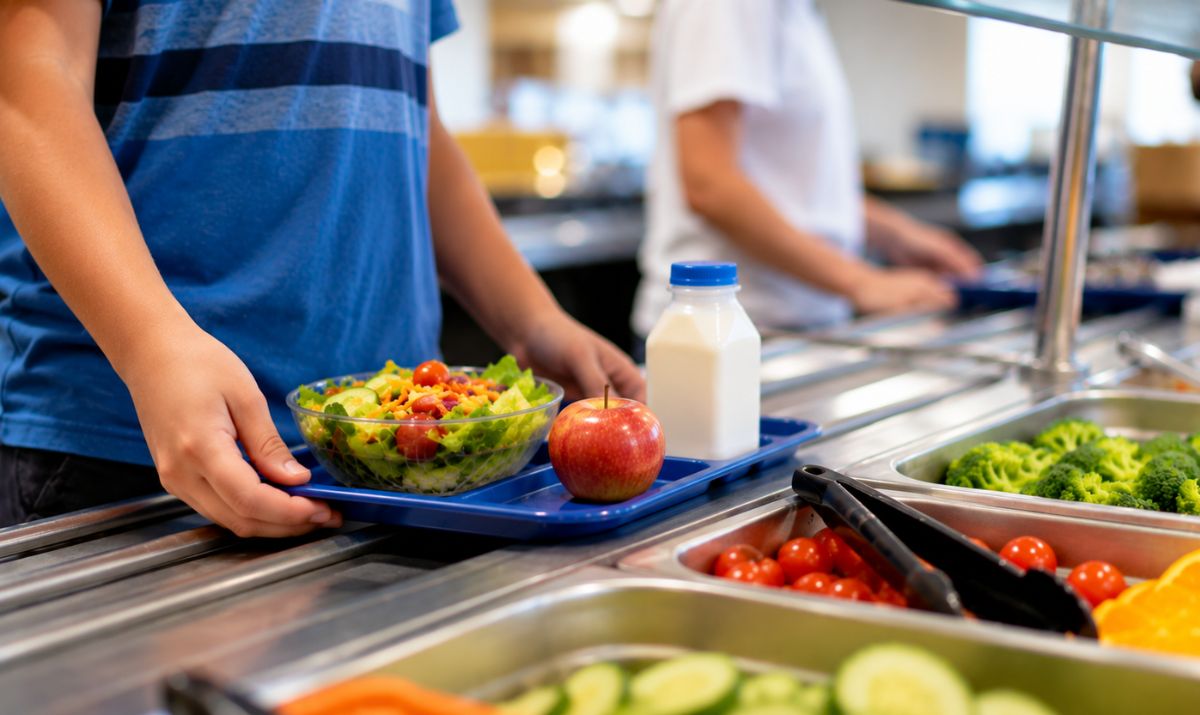
Salad bars give kids variety and control, and they’ll eat more of what they choose themselves. Smaller pan sizes cut waste further and make room for more options, and filling the bar with USDA Foods or DoD Fresh produce adds variety at lower cost. One notable finding: placing the salad bar after the point of purchase was associated with less fruit and vegetable waste.
Sliced fruit is one of the simplest changes with the biggest return. Whole fruit is more likely to be tossed; orange slices and apple wedges are easier and faster to eat. Offering cut fruit has been shown to increase consumption by as much as 70%.
3. Change the schedule: The most consistent win in the research.
Of all the strategies studied, changes to the meal schedule show up most consistently as reducing waste, and they ask very little of the nutrition program itself.
Recess before lunch is a standout. When kids play first and eat second, they’re not rushing through the meal to get outside. Studies associate recess-before-lunch with about 40% less food wasted and 54% more fruits and vegetables eaten, plus a calmer lunchroom.
Enough seat time matters just as much. Students need at least 20 minutes seated and eating, not a 20-minute period that includes waiting in line. Moving from a 20- to a 25-minute lunch has been linked to a 13% drop in waste, and a 30-minute lunch is the recommended best practice. A nationally representative federal study also found that lunch periods starting at noon or later were associated with less waste than earlier ones. Younger kids need extra attention here, since they often get less real eating time and tend to waste more.
4. Recover what’s left: Share tables and donation.
Even a well-run program will have whole food left over. The next best step after source reduction is getting that food to people instead of the landfill.
Share tables are stations where kids can return whole, unopened items they don’t want, like packaged snacks, cartons of milk, and whole fruit, for another student to take at no cost. Items left on the share table can be served again during a later meal, offered through an afterschool snack program, or donated. Share tables must follow food-safety rules, stay supervised, and keep temperature-controlled items safe, but they’re a proven way to keep good food in circulation.
Donation of leftover, wholesome food to food banks and other nonprofits is allowed and encouraged by the USDA. A clear district policy on who handles leftovers, and how, turns an occasional good deed into a repeatable practice.
5. Learn what’s going to waste: Run an audit.
You can’t fix what you can’t see. A food waste audit, whether it’s counting or weighing what gets thrown away, shows exactly which items students are rejecting. It can be as simple as a manager tallying how much fruit and vegetables land in the trash at one lunch or as detailed as the step-by-step process in the USDA, “Guide to Conducting a Student Food Waste Audit.” Either way, the data tells you where to focus, and it turns “we waste a lot of produce” into a specific, fixable list.
6. Bring students in: Student voice is the best way to find out what will go into hungry bellies instead of the trash.
Kids toss less of the food they helped choose. Taste tests, votes on new menu items, contests to name dishes, and cooking demos all build buy-in. Student input feeds right back into menu planning, so next month’s menu reflects what the kids in your district really want to eat.
The Thread Running Through All of It: Visibility
Every strategy here works better when a program can see its own operation clearly. Ordering to real demand, spotting the items students reject, tracking inventory before it spoils, and keeping production aligned with participation depend on data that’s accurate and in one place instead of scattered across spreadsheets and memory.
That’s the role LINQ School Nutrition plays in a food-waste strategy: connecting production, inventory, and participation so a program can buy closer to what students eat, catch waste at the source, and put the savings back into feeding kids. We recently dove into proven ways to use that visibility to reduce food waste, and you can watch the whole conversation on-demand now.
Watch the webinar: Cut K-12 Nutrition Costs With Proven Tips to Reduce Food Waste